The Greeting Card Association’s series of blogs covering Sustainability in the Card Industry is designed to share good practice, celebrating the work that is being done in our industry to reduce our environmental impact and inspire others.
This blog contains the latest information and advice from the Forest Stewardship Council® (FSC®), to ensure your cards are printed on materials that support responsible forestry.
What is FSC?
The Forest Stewardship Council® (FSC®) is an international, non-governmental organisation dedicated to promoting responsible management of the world’s forests. Since its foundation in 1994, FSC has grown to become the world’s most respected and widespread forest certification system.
FSC’s pioneering certification system, which now covers more than 175 million hectares of forest, enables businesses and consumers to choose wood, paper and other forest products that support responsible forestry.
Credible certifications, such as FSC, can offer consumers assurances about the sustainability of the products they choose to buy, and those used and sold by the brands and retailers they shop with. Concern about the environment crosses the generations, so let’s work together to make sure our choices reflect our beliefs and aspirations
Tallulah Chapman, Communications Manager, FSC UK
Greeting Cards and FSC Certification
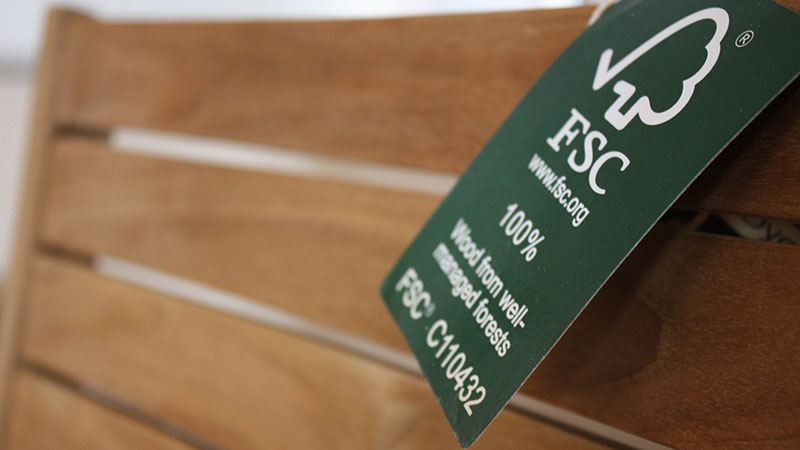
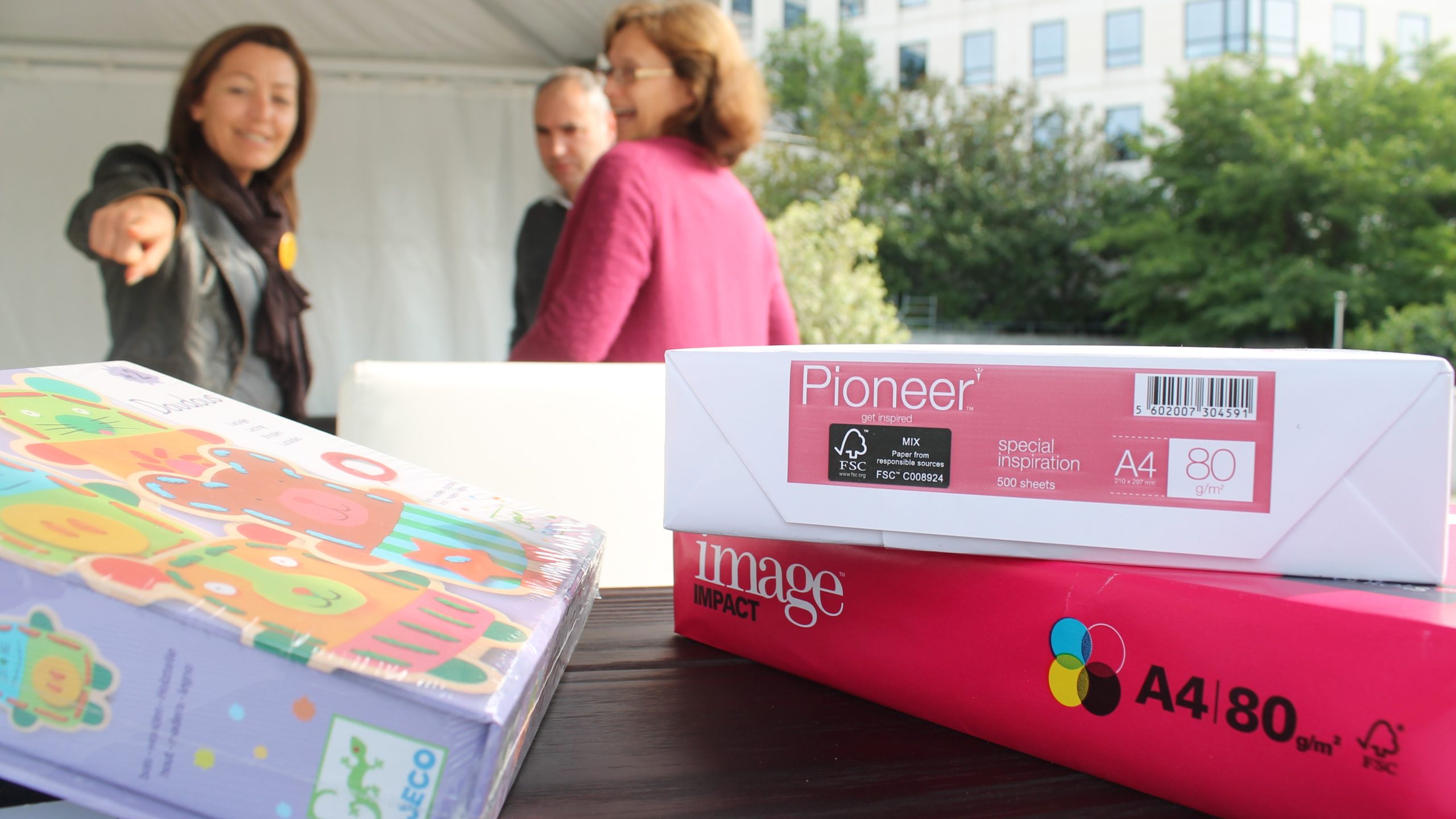
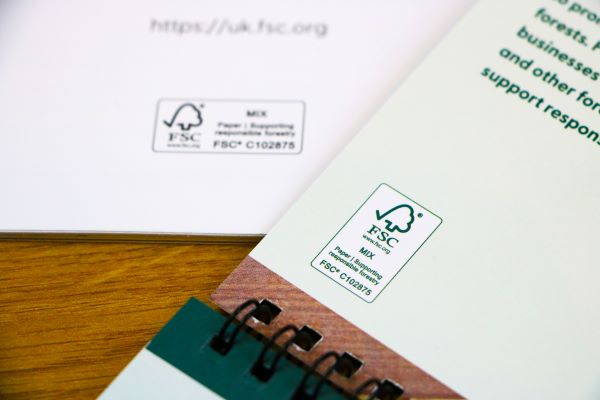
Greeting card publishers can benefit from the FSC certification scheme by using FSC-certified paper and boards for their products. The FSC label on a card indicates to customers the paper used in the product comes from a responsibly managed forest or from recycled or other controlled sources, and will demonstrate a publisher’s commitment to sustainability and the environment. There are three FSC labels: FSC 100%, FSC Recycled and FSC Mix, which are applied depending on the source(s) of the forest-based inputs used to make the product.
Publishers do not have to hold FSC certification to use the FSC label on their products, most will use their printer’s FSC certification. However, publishers can apply for their own certification (see below) and either outsource their printing or print in-house. Holding FSC certification means a publisher is free to use any printer (certified or uncertified) to produce FSC-certified products.
Please remember if you switch the production of your greeting cards from one FSC printer to another FSC printer, or if you change between FSC Mix and FSC 100% recycled board used to make the cards, you must update the artwork on the card to reflect the changes!
Ian Braithwaite, Commercial Manager at Fedrigoni UK
Consumers and businesses are all aware of the need to reduce their environmental footprint, so an FSC message is important to consumers who are looking for environmentally and socially responsible products.
FSC-certified forests
FSC forest management certification confirms that a forest is being managed in a way that preserves biological diversity and benefits the lives of local people and workers, while ensuring it sustains economic viability. There are ten principles that any forest operation must adhere to before it can receive FSC forest management certification. These principles cover a broad range of issues, from maintaining high conservation values to community relations and workers’ rights, as well as monitoring the environmental and social impacts of the forest management.

FSC in the supply chain
FSC Chain of Custody certification verifies that FSC-certified material has been identified and separated from non-certified and uncontrolled material as it makes its way along the supply chain, from the forest, or point of reclamation to the market.
Any company involved in the processing or transformation of FSC-certified products (e.g. manufacturing, repackaging, pack-splitting, relabelling, cutting to size or adding other forest-based components to the product) must be FSC certified in order to apply an FSC label to their products and/or sell them with an FSC claim. FSC chain of custody certification is therefore required by any paper mills, paper merchants and printers that wish to apply the FSC labels or sell products with FSC claims.
FSC-certified materials, labelling and promotion
Paper and other print substrates made from trees are both renewable and recyclable, but only when they are responsibly sourced and considerately processed. FSC-certified printers offer their clients the ability to demonstrate their commitment to responsible sourcing through the use of FSC-certified papers and the application of the FSC labels.
In research conducted in 2025 on behalf of FSC UK, 8 in 10 people in the UK agree that trustworthy certification is important to help people choose more sustainable products. 76% of people in the UK now recognise the FSC logo and almost half of those surveyed are confident they understand, at least roughly, what it means. Once the meaning was explained, 78% said they would prefer to buy a forest product bearing the FSC logo, as opposed to one without,. 73% said they would have a positive opinion of a brand or retailer if they saw the FSC label on their products (Survey of 1279 UK adults conducted in March 2025 by Kantar via OnLineBus).
To ensure that printed materials can carry the FSC label, it is essential that they are produced on FSC-certified materials by a printer or manufacturer covered by a valid FSC chain of custody certificate. Organisations that sell-on FSC-labelled greeting cards, supplied by FSC certificate holders, can be granted authorisation to promote them using the FSC trademarks under an FSC promotional licence, thus facilitating online, offline and in-store promotions. Without holding either FSC certification or a promotional licence, organisations are prohibited from using the FSC trademarks commercially.
Suppliers may tell you, often in good faith, that their supplies are from ‘sustainable’ or ‘managed’ sources, or from plantations. But without credible certification there is often no way to know if products have been sourced responsibly.
FSC certification enables businesses and consumers to choose wood, paper and other forest products made with materials from well-managed forests and/or recycled sources.
Tallulah Chapman, Communications Manager, FSC UK
FSC has added Core Labour Requirements to its chain of custody certification program; designed to ensure FSC-certified products are produced in a socially responsible manner. The requirements include the abolition of child labour, elimination of all forms of forced or compulsory labour, elimination of discrimination with respect to employment and occupation, upholding freedom of association, and the effective recognition of the right to collective bargaining. FSC chain of custody certificate holders must conduct a self-assessment of their conformance with these requirements and be able to demonstrate this to external third-party auditors.
New FSC trademark rules
FSC has published an updated version of its trademark standard, setting out how FSC trademarks can be used by certificate holders. The revised standard, FSC-STD-50-001 Use of the FSC® Trademarks by Certificate Holders (Version 3-0), was released alongside a new companion document, FSC-STD-50-001a Promotional Statements for Certificate Holders (Version 1-0). Both documents became effective on 1st July 2026. To give certificate holders and other users enough time to adjust, FSC has introduced a transition period of two and a half years, running until 1 January 2029.
The revision introduces a number of important updates aimed at improving clarity, consistency, and practical application of FSC trademark rules, while safeguarding the credibility of FSC trademarks. The revision also helps certificate holders comply with emerging anti-greenwashing regulations and supports transparent, trustworthy communication with consumers.
Key changes include:
- Introduction of the FSC QR label, offering new opportunities for digital engagement and consumer interaction.
- Updated requirements for the mandatory elements required when using the FSC label on products, to increase transparency and understanding of the FSC label by consumers.
- More flexibility in graphic design, making it easier to adapt the label to different layouts.
- Removal of the restriction on dual labelling, under defined conditions.
- Retirement of the ‘Forests For All Forever’ mark.
- More ready-to-use promotional statements about FSC and FSC-certified products, now presented in a new standalone addendum.
In line with this revision, FSC has also published a new FSC Trademark Use Guide for Promotional Licence Holders, which includes updated requirements for how retailers and brands communicate about the FSC-certified products they sell or use.
Using an FSC-certified printer
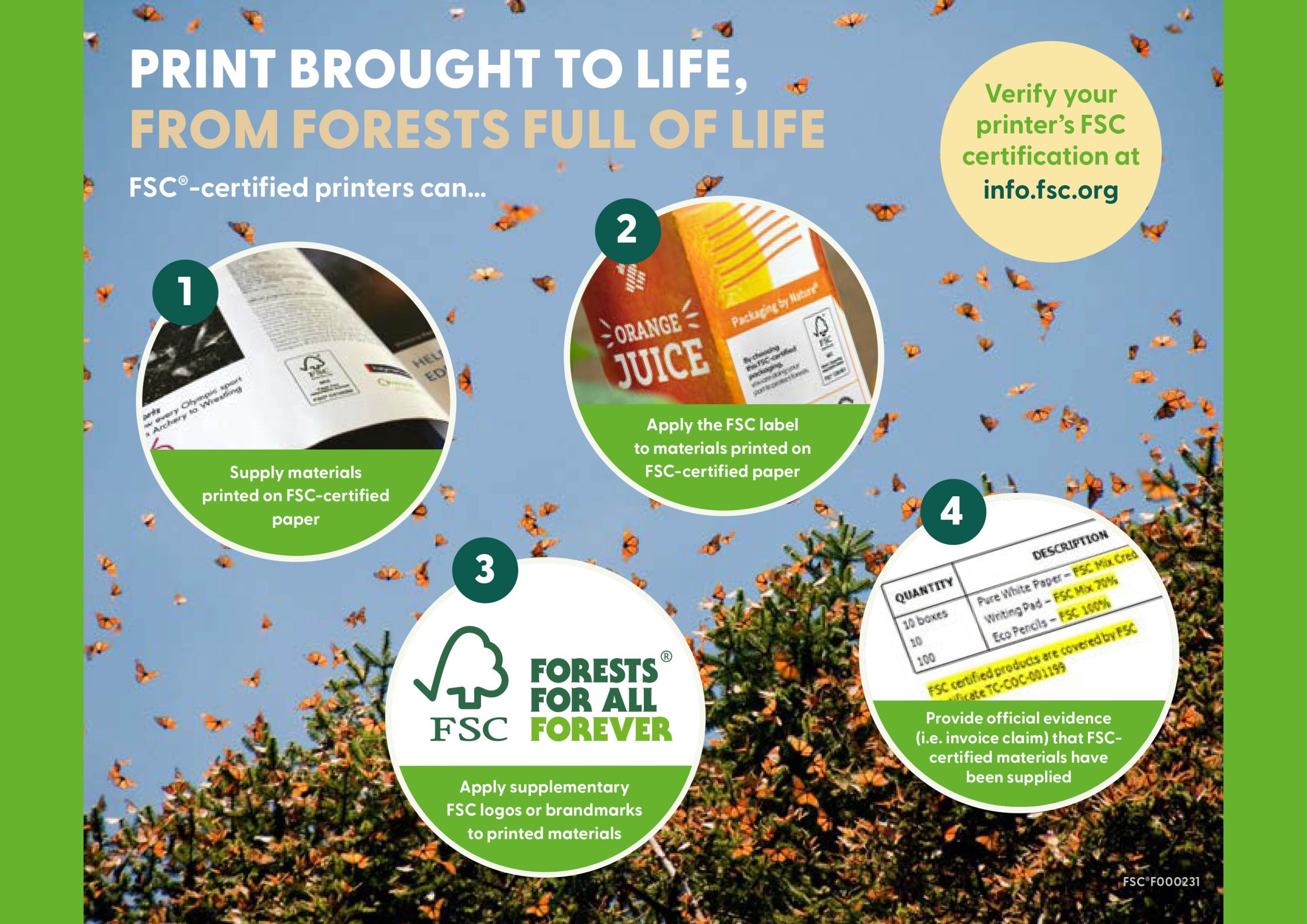
Printed materials can only carry an FSC label if they are produced and labelled under a valid FSC Chain of Custody certificate. To ensure your printed materials carry an FSC label you should:
• Use an FSC-certified printer.
• Specify FSC-certified materials from the outset and request that the printer apply the appropriate FSC label.
• Ensure any supplementary text about FSC is approved by the printer’s FSC-accredited certification body.
To find greeting card specialist printers, recommended by other members, search by ‘printers’ in our Members’ Directory.
Getting FSC certified
Greeting card publishers do not have to hold FSC certification in order to have their cards carry an FSC label (see above) but they may apply for their own certification and either outsource their printing or print in-house. Holding FSC certification means a publisher is free to use any printer (certified or uncertified) to complete print jobs under an outsourcing policy. Certified publishers can use their own licence number within the FSC label and make FSC claims on their outgoing invoices.
To obtain FSC certification, publishers or their printers must follow the FSC Chain of Custody (CoC) certification process, in line with the requirements of the FSC Chain of Custody standard. The CoC certification process ensures that the FSC-certified products are tracked throughout the supply chain, from the forest to the final product. The CoC certification process involves three main steps:
- Initial assessment: The publisher must identify the scope of the certification, including the products and processes to be certified. The publisher must also identify the sources of the raw materials used in the products.
- Implementation: The publisher must implement the necessary procedures to ensure that the FSC-certified products are tracked throughout the supply chain. This includes keeping records of the sources of the raw materials used in the products and ensuring that the FSC-certified products are separated from non-certified products.
- Certification: The publisher must undergo an audit by an FSC-accredited certification body to verify that the CoC procedures are being followed. If the publisher passes the audit, they will be issued with an FSC CoC certificate, an FSC certification code (XXX-COC-000000) and Trademark Licence Code (FSC®C000000).
To new start-ups and even established publishers this can all appear quite daunting. It shouldn’t be – there is lots of help available from specialist industry suppliers and FSC UK [see below]
Ian Braithwaite, Commercial Manager at Fedrigoni UK
Getting a promotional licence
If you buy FSC-labelled products from an FSC-certified supplier, and sell them on unchanged to the public, a promotional licence may offer an alternative to chain of custody certification.
A promotional licence allows an organisation to use the FSC trademarks promotionally, but does not allow it to apply the FSC trademarks to products or sales documents. To get a promotional licence:
• Contact FSC UK
• Complete an application form provide evidence of the certified status of any products your organisation sells/uses
• Sign your FSC licence agreement
• Gain trademark approval and receive an FSC promotional licence code (FSC®N000000)
FAQ’s
Q: Do I have to hold FSC certification to publish FSC-labelled cards?
A: No, but your printer must be FSC certified and printing on FSC-certified materials.
Q: Can I make a text claim instead of using a label?
A: No. The FSC trademark standards do not permit the use of text-only claims such as ‘printed on FSC-certified paper’.
Q: I am publishing FSC-labelled cards but I am selling them with non-FSC envelopes, is this ok?
A: Yes, in this case the label only refers to the product on which it is printed. However, you should not imply that the envelopes are also certified.
Q: Will every card design have to be submitted to the certification body for approval?
A: The approvals process is managed by the FSC certificate holder. A generic format may be approved for use on all your cards as long as an approved FSC label is being properly used and the printer is considered by its certification body to have a good track record.
Q: Does my finishing company need to be FSC certified?
A: No, by this time the cards are already printed with the label, so the finishing company does not need to be certified.
Q: Can I use the FSC trademarks on my website or in a catalogue?
A: Yes, as long as you hold either FSC certification or a promotional licence. Contact FSC UK for further details.
Further information
For latest information and tips on reducing your environmental footprint see the GCA’s Into a Greener Future blog
For GCA member case studies, changes to the law and other important information please visit our members’ library and see our Environment section (please log in to see all relevant information).
Contact FSC UK for advice and guidance on FSC certification, policies and standards. To subscribe to their monthly Forest Matters newsletter visit FSC’s website