An estimated 15% of the UK population is neurodivergent (City & Guilds Index, 2025), a powerful reminder that one size never fits all. As the card industry looks to build a more sustainable and relevant future, it’s vital that we create products that truly reflect the people sending and receiving them.
A growing number of publishers are responding with thoughtful, joyful designs that celebrate neurodiversity and recognise different ways of experiencing the world. The result? More meaningful choices for customers and more authentic ways to connect with loved ones.
We spoke to three publishers leading the way, Dotty Black, Sunshine Lane and Sanders de Roeper to find out a bit more about them, their journey into cards, what inspired their ranges and why this representation matters.
DOTTY BLACK
What’s the name of your company?
My company is called Dotty Black.
When was the company first set up?
I launched Dotty Black in 2019 as an online gift shop alongside my freelance design work. At the time my eldest son was attending many hospital appointments after being diagnosed with Autism and Muscular Dystrophy, so I began building a business, with flexibility around these parameters, whilst exploring my own.
Where is your business based?
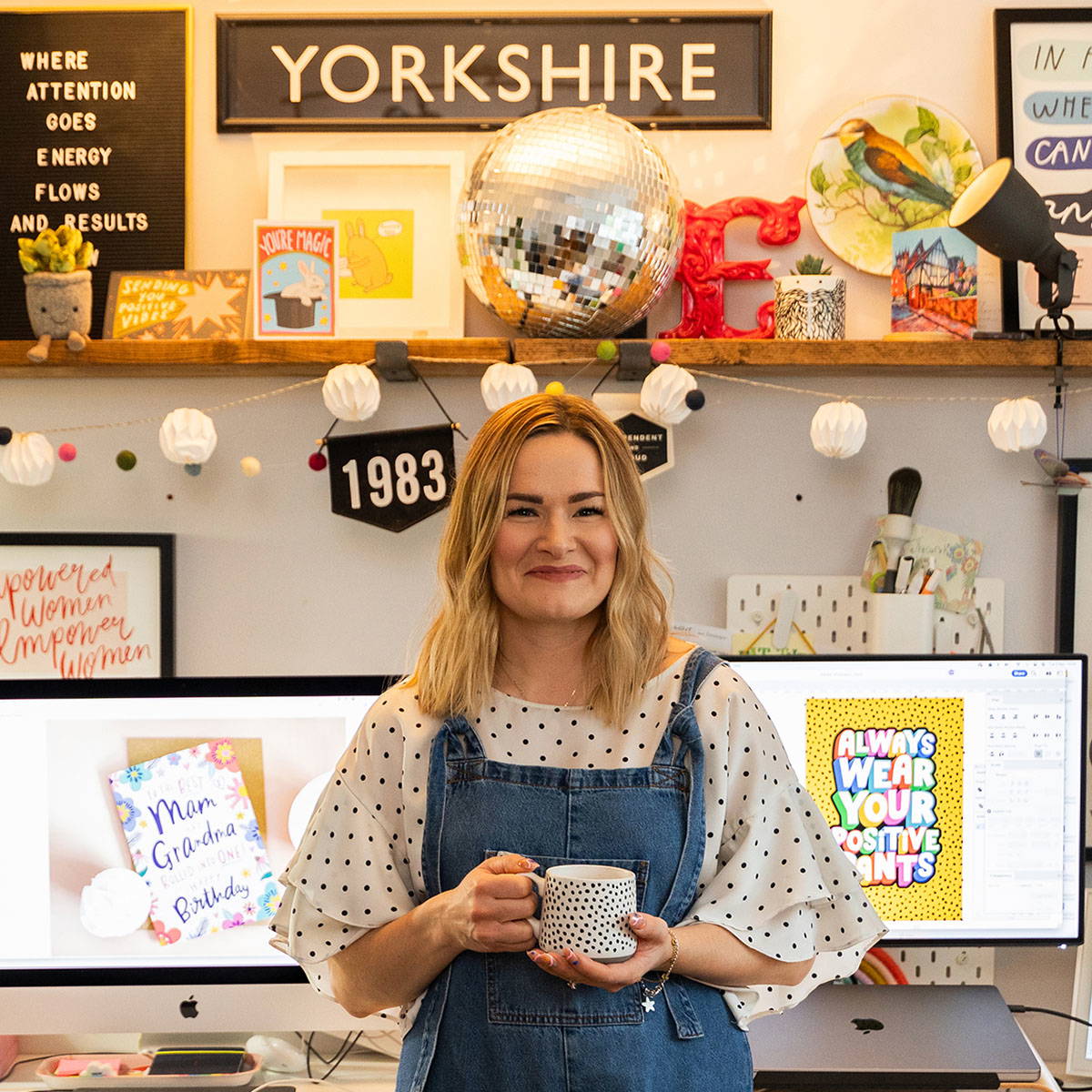
Dotty Black is run from my home studio in Northumberland, just a stone’s throw from Hadrian’s Wall. It’s a peaceful and inspiring place to live and create.
Can you share a little about your background and who you are?
I’m Ebony… a designer, wife and mam to two wonderful boys. I started my career at Hallmark Cards in 2004, working across several teams including own brand ranges for retailers like Next, Morrisons and Paperchase. After becoming a mother, I moved into freelance design in 2014, working with publishers including Pigment, UK Greetings, Hallmark, The Great British Card Company and Danilo.
What first drew you into the world of greeting cards?
Hallmark discovered me at my degree show and it completely changed my career path (in the best way). Walking onto their creative floor for the first time, surrounded by talented designers and illustrators, felt incredible. I’d always loved making cards for friends, so it quickly became a dream job.
What challenges have you faced on your journey so far, and how did you overcome them?
As an independent publisher, managing print minimums and stock risk can be challenging when sales aren’t guaranteed. Thankfully, improvements in digital printing have made smaller runs more viable, allowing me to take creative risks without huge financial commitments.
Looking back, what moment in your career has made you feel most proud?
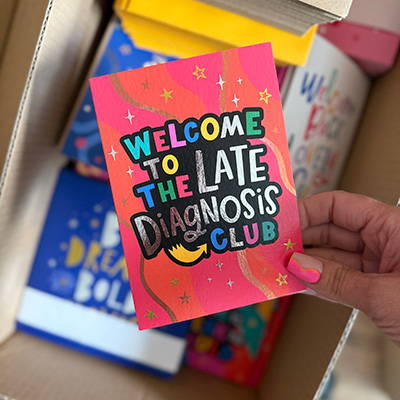
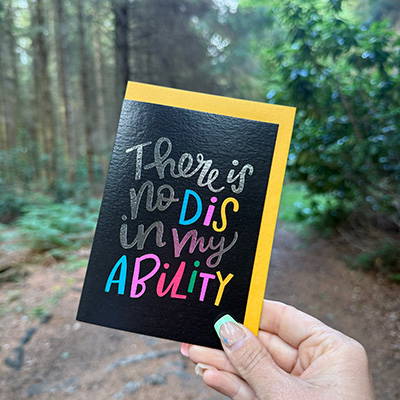
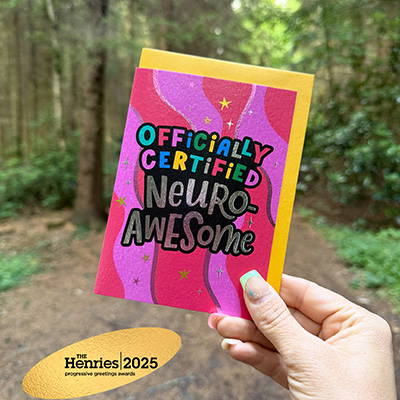
Being shortlisted for ‘Best in Diversity & Inclusion’ Henries Award in 2025, for my Louder Than Labels range was a proud moment. The collection celebrates neurodiversity and supports people navigating diagnosis and identity. As a neurodiverse family, this representation means a lot to me. The range is now also available on Moonpig and raises funds for the charity Tanga, to give something back.
Where do you look for inspiration when creating new card designs?
Most of my inspiration comes from real life experiences. Moments where I wished a certain card existed but couldn’t find one. Because I hand letter most of my designs, the sentiment is just as important as the visual style.
What’s the most memorable card you’ve ever received?
One of my favourites was a personalised birthday card with an illustration of a woman sea dipping… one of my favourite hobbies! It felt thoughtful and unique, especially as it’s not something you typically see on a birthday card.
Do you have a personal favourite card you’ve designed? What makes it special?
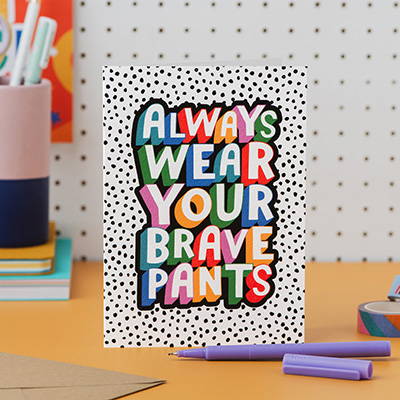
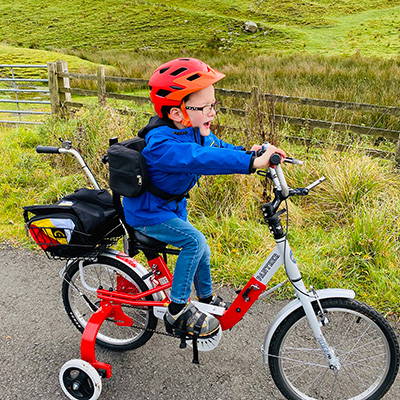
My favourite is “Always Wear Your Brave Pants” from my Power of Positivity range. It was originally an art print inspired by my son and the challenges he faces with his disability. It became a popular motto in many homes after being part of a crowdfunding campaign to help fund an accessible bike for my son. Because of its popularity and meaning, it just had to become a card!
Who or what has had the greatest influence on your creative process?
While working at Hallmark, I helped lead a hand lettering group where designers explored their individual writing styles using traditional tools like ink, nibs and brushes. That experience helped shape my own lettering style, which now features across all of my card ranges.
What excites you most about your work and the business you’ve built?
After 22 years in the greeting card industry, what excites me most is having creative freedom. I can design cards for moments that are often overlooked, creating meaningful designs for people who don’t always see themselves represented in mainstream cards, celebrating our everyday heroes with words we really want a card to say.
What’s next for Dotty Black?
2025 was a big turning point as I stepped away from gift products to focus purely on greeting cards. I launched my first wholesale catalogue, exhibited at my first trade show and began supplying independent retailers, and also Postmark. In 2026 I’m focused on growing those retailer relationships and launching my first full Christmas range.
Sunshine Lane
What’s the name of your company?
Sunshine Lane
When was the company first set up?
2020
Where is your business based?
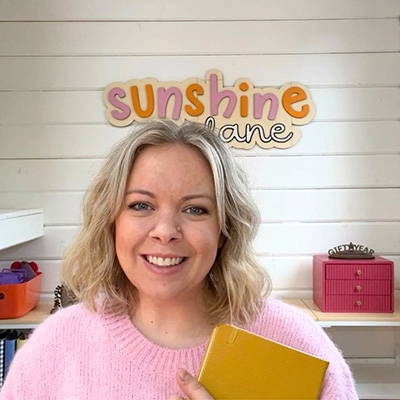
In my home studio in Telford, Shropshire.
Can you share a little about your background and who you are?
I previously worked as a Social Worker supporting children with disabilities and their families. During that time, I
attended training on how autism presents in women – a chance moment that sparked my own journey toward an official diagnosis at age 30. Around the same time, I was managing a chronic illness that led to a decline in my health.
These experiences forced me to make the difficult decision to leave social work and prioritise my wellbeing. I learned the hard way that self-care isn’t a luxury; it’s a necessity. I began creating illustrations with positive messages to process my own journey, and when I saw how deeply they resonated with others, Sunshine Lane was born. Stationery was my first love, so it felt like the natural place to start.
Outside of work, I’m a mum to a bold and hilarious little girl whom we adopted 18 months ago. I love family walks with our dog, Maggie, and trying any new craft I can get my hands on!
What first drew you into the world of greeting cards?
I’ve loved stationery since I was a little girl; I still remember the summer trips my Grandma took me on to pick out supplies for the school year. My mum also taught me the importance of the “perfect” card. She took such care in choosing them, and I followed suit, keeping every card I received in a memory box that I still treasure. To me, a card is a powerful, tangible way to tell someone, “I’m in your corner.”
What challenges have you faced on your journey so far, and how did you overcome them?
As an autistic business owner, things like trade shows and networking can be incredibly draining due to the intense social interaction. However, my passion for spreading messages of self-care and positivity drives me to step out of my comfort zone. I’ve grown so much in confidence, but I’ve also learned to “practice what I preach” by building in decompression time after big events to look after my sensory needs.
Looking back, what moment in your career has made you feel most proud?
It’s a tie between two very different milestones. Professionally, reaching the finals of the Gift of the Year Awards two years running – most recently for our Anxiety Toolkits – was a huge “pinch-me” moment. But on a personal level, nothing beats the messages I get from customers telling me that a card made them feel seen, understood, or less alone. That’s why I do this.
Where do you look for inspiration when creating new card designs?
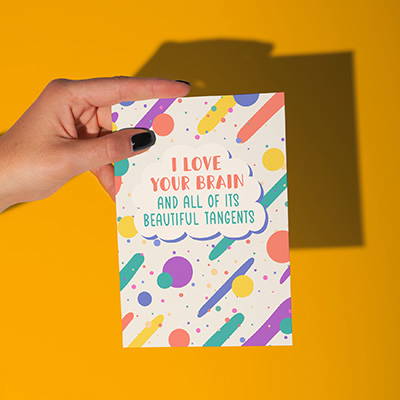
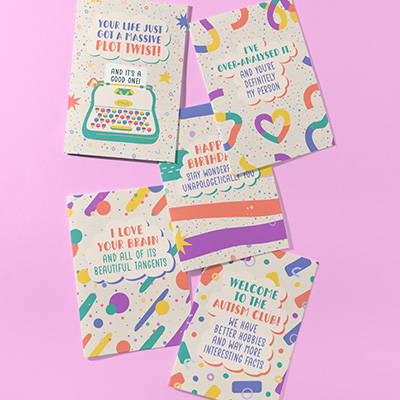
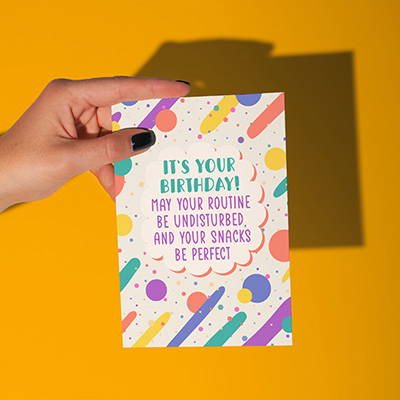
My process almost always starts with the message. I think about the words I needed to hear during my hardest moments, or the things we often forget to say to ourselves. Once I have that core sentiment, I look for imagery that visually represents the tone of the collection. For example, I might use illustrations of wildflowers blooming in harsh conditions to represent resilience and inner strength. Most recently, for my “Wired for Wonderful” range, I wanted the palette to represent the diversity in how people experience the world. I was actually inspired by the fluid, looping shapes a tangle fidget creates when twisted, which resulted in some really fun, maximalist patterns that feel both energetic and inclusive.
What’s the most memorable card you’ve ever received?
When we adopted our daughter, I was overwhelmed by the number of cards that arrived to welcome her. Finding
the “right” card for an adoption isn’t as simple as a traditional “new baby” card (especially since she was 15 months old!), so seeing the effort people took to find inclusive cards meant the world. I’ve started a memory box for her so she can one day see just how much love surrounded her from day one.
Do you have a personal favorite card you’ve designed? What makes it so special to you?
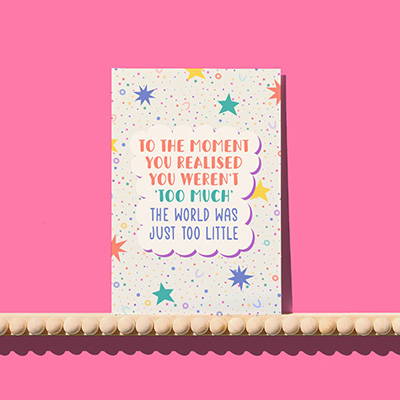
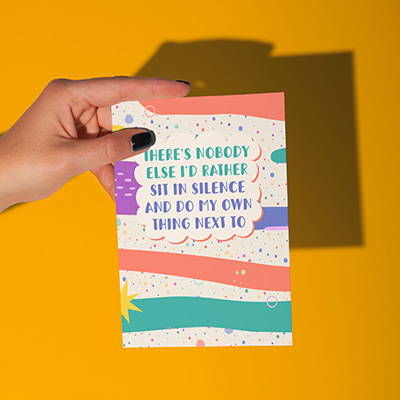
The “Too Much” card (pictured) is incredibly close to my heart. It represents my own journey of moving from a place of feeling misunderstood or “too loud/too sensitive” to a place of radical self-acceptance. It’s a reminder that we don’t need to shrink ourselves to fit into a world that wasn’t built for us.
Who or what has had the greatest influence on your creative process?
My background in Social Work is a massive influence on how I approach design. It taught me the art of truly listening – of understanding what people actually need when they are struggling or celebrating a milestone. That experience helps me write cards that feel authentic and meet people exactly where they are.
Creatively, I was also deeply inspired by a trip to South Korea. I loved the use of joyful characters and playful design I saw, which appealed to people of all ages. It struck me that tackling ‘big’ or difficult emotions doesn’t always have to be ‘serious.’ Sometimes, the best way to reach someone is through a lens that is warm, relatable, or even a little bit ‘silly.’ That blend of deep, meaningful sentiment and light-hearted design is at the heart of Sunshine Lane.
What excites you most about your work and the business you’ve built?
The journey from a tiny spark of an idea to seeing a physical product in a customer’s hands (or on a
retailer’s shelf!) never gets old. Knowing that a shop owner believed in my vision enough to stock it is a wonderful feeling.
What’s next for Sunshine Lane?
We are currently working on a brand-new collection that bridges the gap between greetings and gifts: cards for all occasions featuring beautiful wooden keepsakes. I’m also really excited (and a little nervous!) to be attending the GCA’s Dragons Speed Dating event for the first time to share these new designs with retailers!
Sanders De Roeper
What’s the name of your company?
Sanders de Roeper, which is a fusion of our surnames Tim Sanders and Hatty de Roeper.
Where is your business based?
Hastings, East Sussex. Our studio is at The Yard, Waterworks Road, very nearby to our home.
Can you share a little about your background and who you are?
We are a husband and wife design duo who first met while studying Graphic Design and Fashion Design at Kingston University, London. We graduated back in 2010. Hatty went on to complete her MA at the Royal College of Art.
A few years later we reconnected while both living in North London, and quickly realised we shared not only a creative vision but a similar way of approaching life, working hard and embracing everything at full pace. Those years were full of energy and fun, though we have since come to understand them more clearly after both being diagnosed as neurodivergent, something that has shaped how we work and live.
We also spent time living and working in Amsterdam before starting a family and relocating to Hastings. With Tim having grown up in Brighton, the move to the coast felt like a natural step, offering a shift in pace and perspective, even if life with a young family and a creative startup remains anything but slow.
What first drew you into the world of greeting cards?
Sanders de Roeper was born from a personal and creative turning point. After theloss of Tim’s mother, COVID, and becoming parents, we wanted to create work felt like it mattered. It really stemmed from a time of loneliness for both of us. We set out to build a community through inclusive, emotionally resonant art, blending humour, warmth, and sincerity. At its heart, our work celebrates ageless optimism, speaks to the inner child, and creates small moments of connection. Shaped by our experiences, including our own neurodivergent experiences. Sanders de Roeper is also about building a life and work that works for us.
What challenges have you faced on your journey so far, and how did you overcome them?
The main challenge we face is the level of investment required to scale the business to a point where it can sustainably support our family of four. It has demanded both financial commitment and resilience, but we truly believe in what we are building. We believe in the risks we have taken, which helps us hold our nerve as we commit to this undertaking.
Looking back, what moment in your career has made you feel most proud?
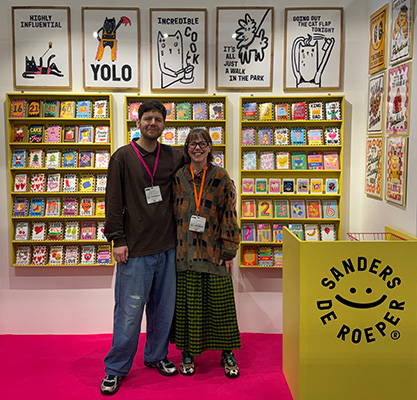
Without doubt, the opening of our newest Sanders de Roeper studio in Hastings, which is a dream come true. It’s a place to work, create, and connect. Open to the public Fridays and Saturdays, the studio has been described as a joyful act of resistance. A happy place for ourselves and our community. It inspires us to keep creating and developing the Sanders de Roeper world.
Where do you look for inspiration when creating new card designs?
Our ideas often begin with conversations, then evolve through doodling and playful experimentation into visual outcomes. We are inspired by the everyday, emotionally expressive cartoon, fantasy, pop culture, meme culture, music, sentiment, typography, colour and art more broadly/ life! It’s a melting pot.
Our design identity has also been shaped by the realities of time, and we have learned to embrace that. While we love painting and drawing, we are equally drawn to the flexibility of digital work, which allows us to move in and out of the process organically and develop multiple ideas in tandem.
Not everything we create makes it to a final outcome, and we see that as a natural and necessary part of the process. What drives us is the idea of connection, placing expression over perfection. That belief underpins much of what we do.
What’s the most memorable card you’ve ever received?
Tim: My mate John Barnett has made me some incredible custom cards on Moonpig over the years that have genuinely been hilarious. He’s a graphic designer too, so he superimposes photos of me into iconic album covers and all sorts, but it’s really his wit that makes them. They’ve always stuck with me. There’s something about that format that really invites silly, creative ideas, and those are the ones that end up being the most memorable for me.
Hatty: I’ve always been someone who keeps cards. My Granny used to send me lots of Quentin Blake ones, and she wrote me letters too, which I still read from time to time. My grandmother on my mum’s side also made and sold hand-painted cards. She created a beautiful passion flower design that I love so much I’ve framed it, I’ll always love passion flowers because of that card. My grandparents are no longer with us, but I cherish the keepsakes with their handwriting. There is something about the pen, the ink, and the distinct shapes of their lettering. To me, these details feel tied to someone’s identity, and I’m grateful to have them when I can no longer speak to them.
Do you have a personal favourite card you’ve designed? What makes it so special to you?
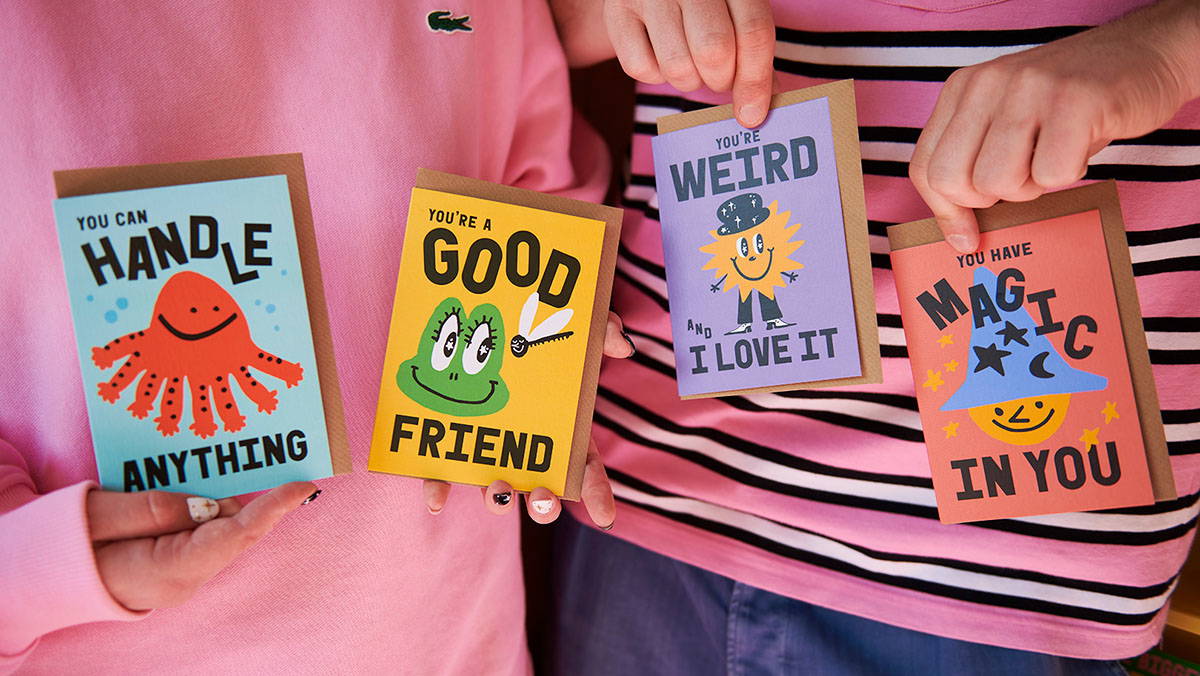
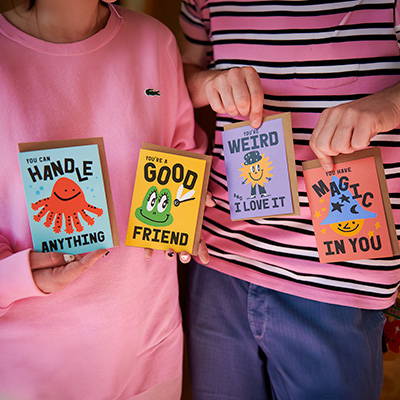
We both love the “you have magic in you” card with the wizard. It really captures that sense of childlike wonder, something we feel is so important for adults to reconnect with.
We genuinely believe there are so many people out there with untapped magic inside them. If we can encourage even a little more self belief in one another, it can lead to happier communities, stronger support networks, and more people bringing their unique skills into the world. It might be a small, slightly silly card, but there’s a big idea behind it.
Who or what has had the greatest influence on your creative process?
No matter who you are, your circumstances, or what you may be facing, there is always the opportunity to create and hold onto small, meaningful experiences.
At Sanders de Roeper, we believe in embracing both the highs and the lows as essential parts of a full and unique life. Our aim is to help people cherish their time here, capture the little but important moments, and leave behind a visual legacy. The only certainty in life is that we will all die, and as morbid as that sounds, it drives us to live intentionally
What excites you most about your work and the business you’ve built?
The unexpected. The hope that serendipitous moments could change our business forever. We are inspired by the excitement of possibility, of learning, developing, and showing our children that if you believe in something enough, you might actually be able to make it happen. That is the million-dollar question! For now, each day is a building block. We build, we feel, we create, and we graft. We are enjoying the journey, and our hope is simply to continue doing this for as long as possible.
What’s next for Sanders de Roeper?
We want nothing more than to create something special, that creates financial security for us at the same time. With that comes an opportunity to thank every person who has supported our business so far. That belief and support in our vision has been so humbling.