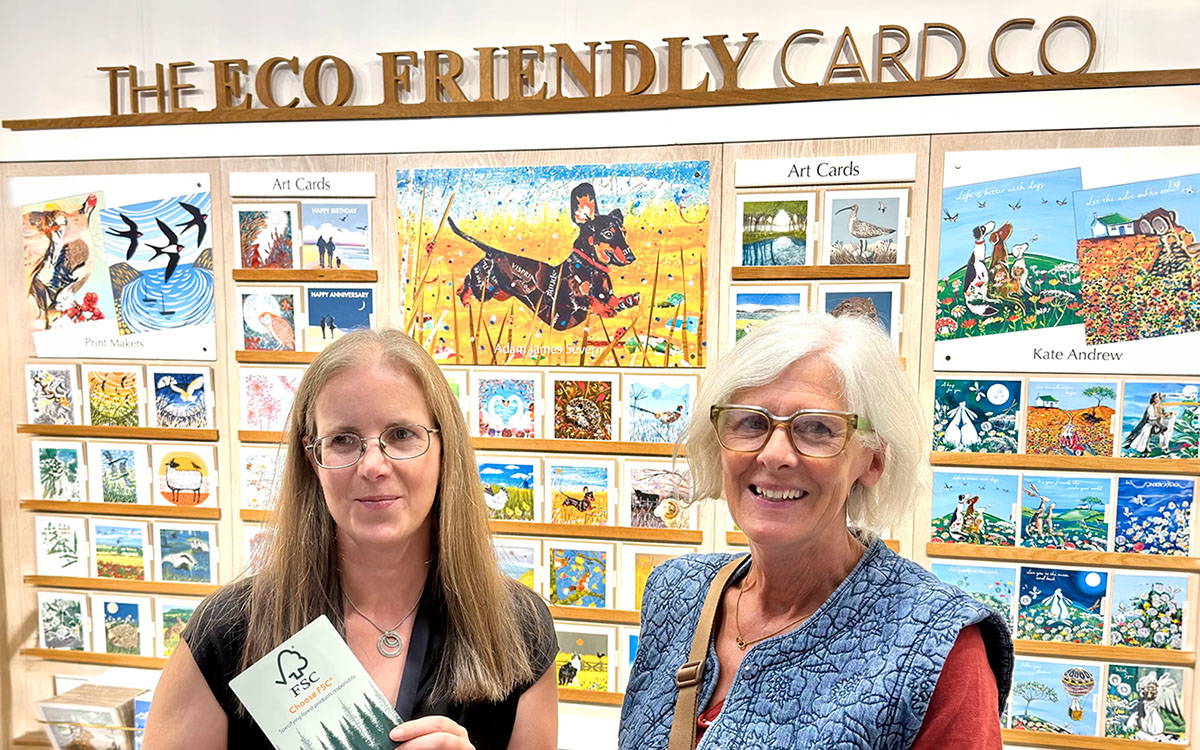
The Greeting Card Association’s series of blogs covering Sustainability in the Card Industry is designed to share good practice, celebrating the work being done across our industry to reduce environmental impact and inspire others.
In this guest blog, Sue Morrish, founder of The Eco-Friendly Card Co and a member of the GCA Sustainability Committee, reflects on three decades of championing environmentally responsible publishing.
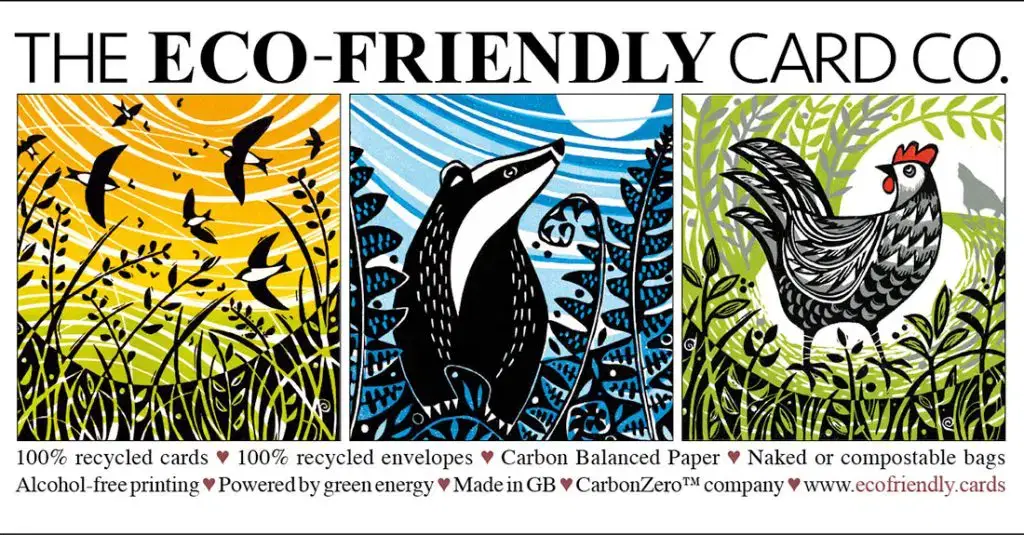
Long before sustainability became a mainstream business priority, Sue and her team were exploring ways to reduce waste, increase recycled content and make more considered choices about the products they created. From introducing compostable packaging and achieving FSC certification to investing in solar power and reducing their carbon footprint, The Eco-Friendly Card Co has continually looked for ways to lessen its environmental impact.
Here, Sue shares some of the lessons learned, challenges faced and progress made over the past 30 years, along with why she believes businesses should never stop looking for ways to do better.
Reflections on 30 Years…
When I first tried to sell cards I didn’t know anything about them. I was an avid letter writer as a child, so I approved of the idea of cards. Everything else to do with cards was a complete mystery to me.
What I did know, however, was that we wanted to tread gently on the earth. It was the nineties; there was already talk of global warming (largely ignored by industry) and the importance of recycling (often dismissed as being too complicated). We’d been inspired by places like the Eden Project and the Centre for Alternative Technology which proved you could do things differently. Likewise, books like Fred Pearce’s Confessions of an Eco-Sinner, Lawrence Osborn’s Guardians of Creation and Richard Girling’s Rubbish made us want to reflect our values in the way we ran our business.
The First Steps
Our first environmental commitment, in the late nineties, was to only use 100% recycled envelopes for our cards. After all, why cut down a tree for an envelope that’s just going to be screwed up and thrown away?
That first step was the easiest, but didn’t address the card itself, or the packaging. This was where strong relationships with suppliers became really important.
In 2006 we became the first card publisher to use cornstarch bags for cards, in part because we’d been nagging our bag suppliers for years for an alternative to fossil-fuel-based plastics.
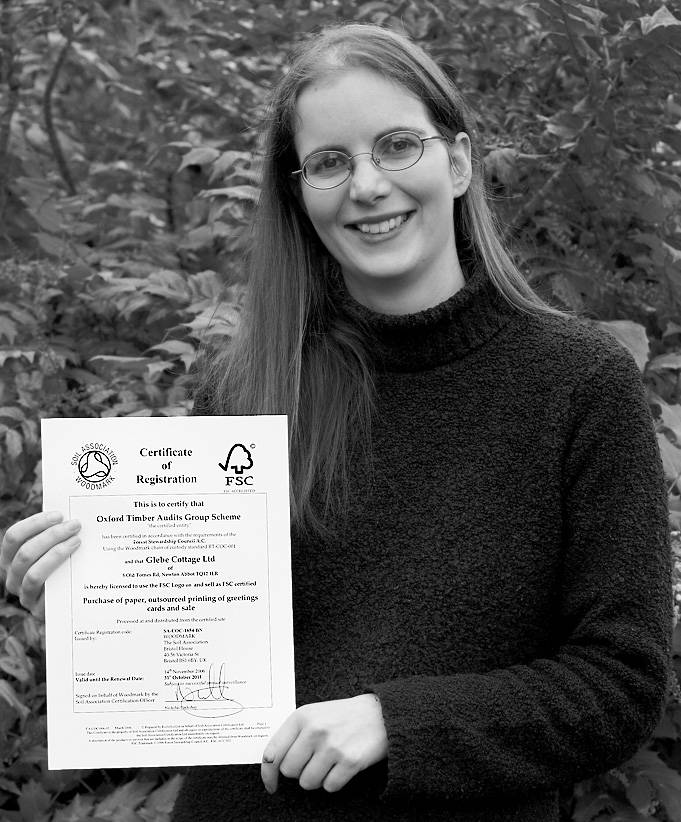
Then later that same year we became the first UK DTR card publisher to become FSC certified and hold our own chain of custody. At last we didn’t have to use vague phrases about “sustainable forests” but could verify our cards didn’t contribute to deforestation by having the FSC tick-tree symbol on the back of our cards.
Working with Suppliers to Make Change Happen
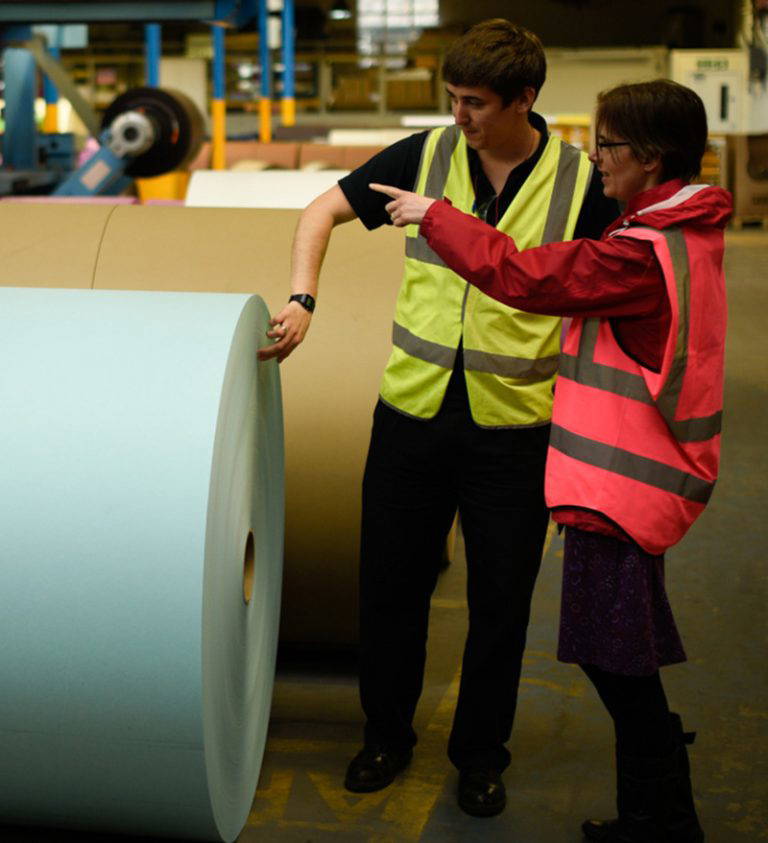
Having our own chain of custody opened up new opportunities for us with regards to board. Now we could commission our own board which had a recycled content.
We’d been told that recycled paper was too expensive, poor quality or printed badly and we couldn’t get what we wanted off-the-shelf. Again, by nagging our paper merchants we found mills that were happy to make FSC-certified coated board for cards with a 50% recycled content.
Creating Our Eco-Commitments
Later in 2007 we launched our “Eco-commitments”, a list of promises that we would stick to when making our cards:
We’ve stuck to this list of commitments over the last 20 years, with a few tweaks. Now all our cards are 100% recycled as well as FSC, our cards have been printed waterless with no industrial alcohol for at least a decade, we’ve added Carbon Balancing of all our paper with The World Land Trust, and now 75% of our cards are sold with no bag at all.

Lessons Learned Along the Way
Also in 2007 there was a brief dalliance with The Carbon Neutral Company®, as we wanted to offset our Class 1 and 2 carbon emissions.
However, we soon felt this wasn’t aligned with our values as a business when it turned out that carbon offsetting was through building wind-power units for the Chinese government.
We quickly moved to CO₂ Balance, which worked with impoverished communities in Kenya, building enclosed stoves for women to cook on. This meant people used far less fuel for cooking but also had radical health benefits by reducing exposure to harmful smoke.
Back in the nineties, the success of the Fairtrade movement had shown that what people buy, and therefore who and what you choose to support, can make a difference.
We wanted to find ways of talking about our cards, and how we felt they were different, when it came to their impact on the environment.
Finding the Right Language
We developed the idea of the “green shopping theory”, the idea that what we buy can change the world through greener consumer choices, and talked about “environmentally responsible publishing”.
We designed a paper slip to go inside our cards, outlining the steps we’d taken as a business to make our products greener. We labelled our products as “environmentally responsible”, but the language was too dense and wasn’t easily understood by retailers or consumers.
Meanwhile, we noticed other card publishers beginning to describe their products as “green” or “eco-friendly” without necessarily providing evidence to support those claims. Unsurprisingly, retailers often assumed those products were better for the environment than our “environmentally responsible” cards.
We’d won Green Apple and Business Commitment to the Environment awards, yet realised we weren’t communicating our USP effectively.
This caused furious debate inside Glebe Cottage, which is what we’d been trading as for almost 20 years.
We’d been reluctant to use the words “green” or “eco-friendly”. After all, is anything we buy truly eco-friendly at the end of the day?
But the hard truth was that when retailers and consumers were looking for products that were kinder to the environment, they responded to easy-to-understand language.
We started calling ourselves Glebe Cottage – The Eco-Friendly Card Co in 2015 and by 2017 had fully transitioned to trading as The Eco-Friendly Card Co.
Backing Up Environmental Claims
I’m surprised how few retailers ask us, “What makes you eco-friendly?”
Maybe people assume it does what it says on the tin, but it’s really important to be able to back up any environmental claim.
A bullet-point list of our Eco-commitments is printed on the back of every card we publish, along with directions to visit our website for more information. We also provide detailed information about our commitments in our brochures and online.
All the environmental initiatives we’ve undertaken are because being environmentally responsible matters to us. Not because of legislation, and not because of demands from larger retailers and their CSR policies.
Staying Restless
We’re aware there is always something else you can do to reduce your environmental footprint.
We consider the environment in our commercial relationships, refusing those which are unnecessarily wasteful.
Recently we’ve been working on solutions for release liner recycling and have been working with Terracycle for industrial composting of our bags.
We’ve started booking smaller trade show stands so we can travel in our EV rather than hiring a van. A smaller stand has a lower carbon footprint.
And we’ve recently installed solar panels, which had been on the wish-list for a long time.
In his film How to Live on Earth, Benedict Cumberbatch says, “It’s time to rethink everything.”
Recently I watched the People’s Emergency Briefing and the scale and consequences of the climate emergency coming down the line are truly shocking. I don’t think it’s possible to watch that and walk away without asking, “What more can I be doing?”
I guess if there is one takeaway from this article it would be: stay restless.
Don’t wait for legislation to make things change. Do what you can and then do more.
There is so much advice and support available from organisations such as the GCA and Products of Change. There are podcasts from organisations like The Ellen MacArthur Foundation which provide an international perspective, and local Action on Climate Change and Freecycle groups which can connect you with like-minded people.
It’s possible to feel overwhelmed by all of this, but remember, in the words of Greta Thunberg:
“No one is too small to make a difference.”
If you have a story to tell, or information on changes you have made to your business to share, please contact the GCA so that we can showcase your journey and inspire others across the greeting card industry.